

|
|

For many years, Julie Andrews dreamed of creating a show with her daughter, Emma Walton Hamilton, which would impart an appreciation of the arts to children. This year she got her wish. The Jim Henson Co., famous for its Muppets, contacted Andrews and asked if she would be interested in partnering for a production with this very concept.
“My heart leapt,” Andrews told The Advocate. “I said yes! I have! And that would appeal very much, because both Emma and I are passionate advocates of the arts and try to speak for them whenever we can. So this was a no-brainer.”
Julie’s Greenroom, a new Netflix series, is the fruit of this collaboration. It premiered in March and is now introducing a new generation of young people to the magic of the theater as well as the behind-the-scenes of how it is staged. It’s the latest creative effort from the mother-and-daughter team, who together have written over 30 children’s books and produced several plays at a regional theater cofounded by Walton.
Andrews and Hamilton love working together for many reasons. “If you have about three hours, I could go over her many virtues,” Walton said of her mother, with a laugh. “Because we’re mother and daughter, because we’ve worked together for so many years, we intuitively know what the other one is thinking [and] feeling. We’re able to finish each other’s sentences. But we do have very different and complementary strengths.”
In addition to teaching kids, one of the reasons Hamilton and Andrews created Julie’s Greenroomwas to advocate for the arts, particularly in an era when they are under attack. “They are the first thing to be cut in budgets and schools and of course at the administrative level,” Hamilton bemoaned. “So from our point of view, we really wanted to advocate for them, because we are so aware of how essential they are.”
The Trump administration infamously threatened to cut the budget of the National Endowment for the Arts. Although the immediate threat to its funding may have passed, Andrews and Hamilton have a message for any political administration that is considering such cuts.

WE HAVE grown accustomed to her face. Accustomed to the blossom in her cheeks, the bluish twinkle in her eyes.
But Dame Julie Andrews still has the sort of star power no amount of familiarity can erase.
Slipping into her seat at the opening of My Fair Lady in Brisbane, wearing dark glasses, the beloved stage and screen star was easily spotted. And, as the lights dimmed ahead of
the overture, ripples of applause swelled into a tsunami of affection.
A sustained roar that had the original Eliza Doolittle — not to mention Mary Poppins and Maria von Trapp — standing briefly and waving back with embarrassed thanks.
“Goodness me, what an ovation,’’ the 81-year-old says the morning after.
But Andrews — directing an Australian revival of Lerner and Loewe’s classic Broadway musical — is quick to swivel the spotlight.
“This Australian company, they work so hard and give me everything I could possibly ask for,’’ she says. “I think of them almost as my second family.’’
Andrews — sauntering into a hotel anteroom in floral jacket, black slacks and suede shoes — seems especially taken with Anna O’Byrne, the Melbourne singer (Love Never Dies) cast as Eliza in her acclaimed 60th anniversary production.
“Anna is wonderful,’’ she says. “Her voice is gorgeous and she’s finding things in the role that I’m thrilled about, things I would never have thought of.’’
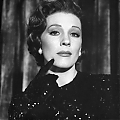
Andrews was only 20, with just one big show under her belt (The Boyfriend), when she landed the coveted role of Eliza opposite Rex Harrison’s Professor Henry Higgins. They were the toast of Broadway after My Fair Lady opened in New York on March 15, 1956. Audiences seeing the show on London’s West End were just as ecstatic.
“I did My Fair Lady for almost 3½ years, eight performances a week,’’ Andrews recalls. “It was a marathon.’’
No archival record remains of that astounding production. Eliza — the Covent Garden flower seller transformed from a “squashed cabbage leaf’’ into an English rose — was defined instead by Audrey Hepburn in the Oscar-winning 1964 Hollywood movie My Fair Lady.
“Audrey and I became good friends and one day she said to me, ‘Julie, you should have done the role (on screen) … but I didn’t have the guts to turn it down’,” Andrews says. “In fact, that’s not the reason I didn’t do it. Not because Audrey wanted it but because I wasn’t known
at that time. On Broadway I was known but they (Hollywood producers) wanted a huge box-office name.’’
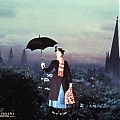
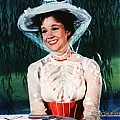
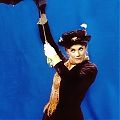
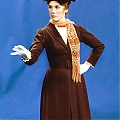
Ironically, at the 1965 Academy Awards, it was Andrews — not Hepburn — who claimed the Best Actress Oscar: for Mary Poppins. Walt Disney had seen Andrews as Guinevere in Camelot — the fabled Lerner and Loewe musical that followed My Fair Lady — and decided she was “practically perfect’’ to play P.L. Travers’ magical nanny.
Mary Poppins opened the door to The Sound of Music, where Andrews’ do-re-mi charm
in the Bavarian Alps, and mastery of Rodgers and Hammerstein music, earned her another Oscar nomination.
“I was the lucky lady asked to do those roles,’’ she says airily.
But was this dream run just luck or good judgment?
“Young students ask me (that) all the time … where the good fortune comes in is, you never know when a great role is going to float past,” she says. “The thing is, do your homework.
Be ready when they do.’’
This is the sort of sensible advice Andrews dispenses on Julie’s Greenroom, a new Netflix show where she joins Jim Henson puppets (her “Greenies”) in teaching kids — and kids at heart — about the “beautiful world of the arts’’.
“I did a lot of touring in my youth,’’ she says, “and I learnt very quickly that giving is what
it’s all about. It’s about the gift of making an audience feel great and forget their cares, if only for a few hours.’’
But do actors ever really learn how to handle success? The Sound of Music, a megahit, made Andrews the America’s biggest film star in 1966.
“It certainly knocked me sideways for a while,’’ she says. “There’s a great wave of people coming at you and it does take a certain amount of discipline.
“You have to collect yourself, keep your head and realise this is not the way it’s always going to be. It’s a dream life for a little while.’’