Julie Andrews shares a behind-the-scenes look at the opening sequence of ‘The Sound of Music’
By Julie Andrews with Emma Walton Hamilton
Oct 12 2019
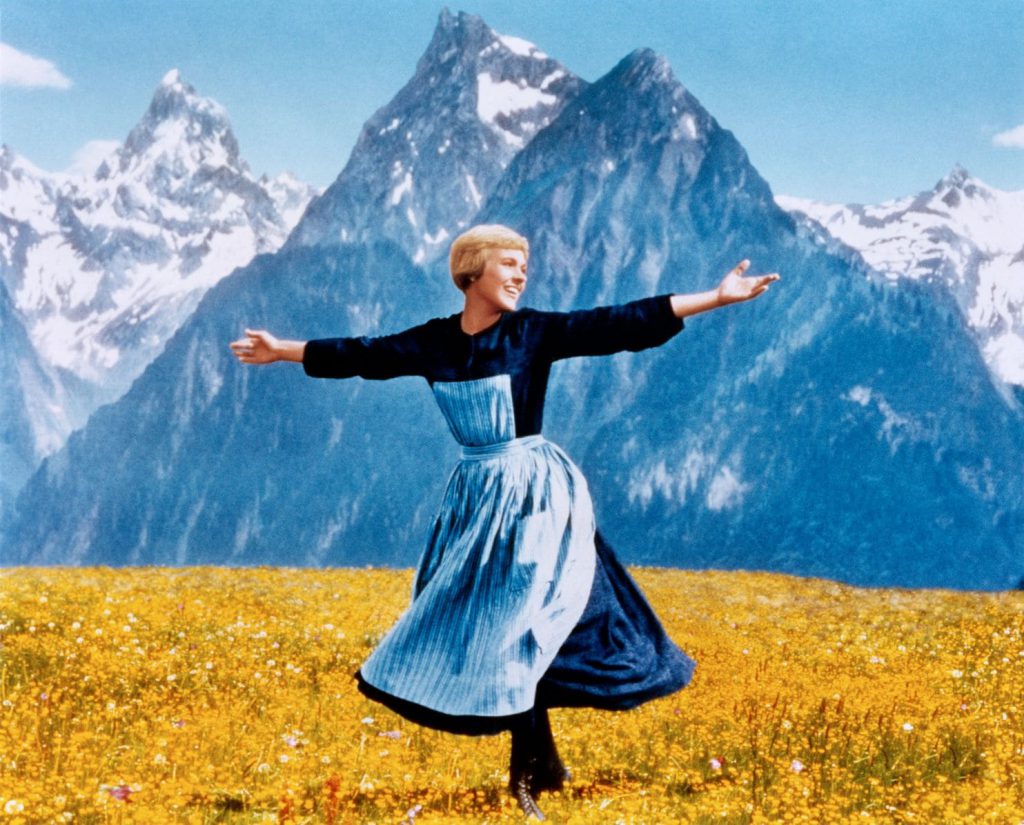
The following comes from the book “Home Work: A Memoir of My Hollywood Years.” In this excerpt, Julie Andrews looks back on filming the iconic opening sequence of “The Sound of Music.”
Ironically, most of our film’s magical opening sequence was the last thing we filmed in Austria. Robert Wise, our director, had envisioned an aerial shot to be filmed from a helicopter that would discover me — a speck in the vast alpine landscape — walking toward the camera. He selected a beautiful stretch of countryside high in the mountains, flanked by woods on two sides. Our huge playback speakers were camouflaged among the trees, as was our crew, so that no one else was in view.
I was placed at one end of the meadow. A helicopter hovered behind the trees at the other end, waiting for me to begin my walk toward it. Initially, I couldn’t hear my cue since the crew’s voices were muffled by the trees. Even the playback, turned up as loud as possible, was almost inaudible over the “clackety-clack” of the helicopter. Finally, Marc Breaux was given a bullhorn, through which he yelled, “GO, JULIE!”
I began my walk, and as I did, the helicopter rose up and over its cover. It came at me sideways, looking rather like a giant crab. A brave cameraman named Paul Beeson was hanging out of it, strapped precariously to the side where a door would have been, his feet resting on the runners beneath the craft. Strapped to him was the heavy camera equipment. As the helicopter drew closer, I spun around with my arms open as if about to sing. All I had to do was walk, twirl, and take a breath. This required several takes, to be sure that both the helicopter and I hit our marks correctly, the camera was in focus, there was no helicopter shadow, and that everything timed out. Once the take was complete, the helicopter soared up and around me and returned to its original position. At that point I’d run back to the end of the field to start all over again, until Bob was satisfied that he had the perfect take.
The problem was that as I completed that spin and the helicopter lifted, the downdraft from the jet engine was so powerful, it dashed me to the ground. I’d haul myself up, spitting mud and grass and brushing it off my dress, and trek back to my starting position. Each time the helicopter encircled me, I was flattened again.
I became more and more irritated—couldn’t they see what was happening? I tried to indicate for them to make a wider circle around me. I could see the cameraman, the pilot, and our second unit director on board, but all I got was a thumbs-up and a signal to do it again. Finally, the shot was deemed acceptable, and I was grateful to return to my hotel and take a long, hot bath.
By this time, largely due to the weather, we were three weeks behind schedule, seriously over budget, and the studio had summoned the rest of the cast back to L.A. We tried to capture the next small section of the song for several days, but the relentless rain thwarted our attempts yet again. Day after day, we waited for a break in the clouds, everyone cold, damp, and longing to go home.
There was still quite a bit left to shoot, as each small segment of the song was its own little scene. The brook, for example, was actually man-made, dug out by our crew, lined with plastic and filled with water, boulders, and ferns. Our host farmer lost patience with us, claiming that the film crew’s presence was disrupting his cows’ milk production. Overnight, he took a pitchfork to the plastic lining and punctured it enough times that all the water drained away. Bob was devastated—the 20th Century Fox bigwigs were hounding him to wrap things up, but they had no idea of the obstacles that he was wrestling with.
Finally, Bob promised the studio that if he didn’t get the last shot he was waiting for, he’d wrap the company nonetheless and come home the following day. By some miracle, that afternoon the clouds parted for a brief half hour, the sun came out, and we got our shot. Bob later said that those constant lowering cumuli set against the magnificent Alps gave the film the drama and authenticity it needed — something we couldn’t have achieved any other way.
From the book “Home Work” by Julie Andrews. Copyright © 2019 by Lacebark Entertainment, Inc. Reprinted by permission of Hachette Books, New York, N.Y. All rights reserved.
Julie Andrews is an Oscar-winning actress whose film credits include “Mary Poppins,” “The Sound of Music” and “Victor Victoria.” Emma Walton Hamilton, with her mother, Andrews, has written more than 30 books for children and young adults.
By Julie Andrews and Emma Walton Hamilton
Hachette. 352 pp. $30