|
|
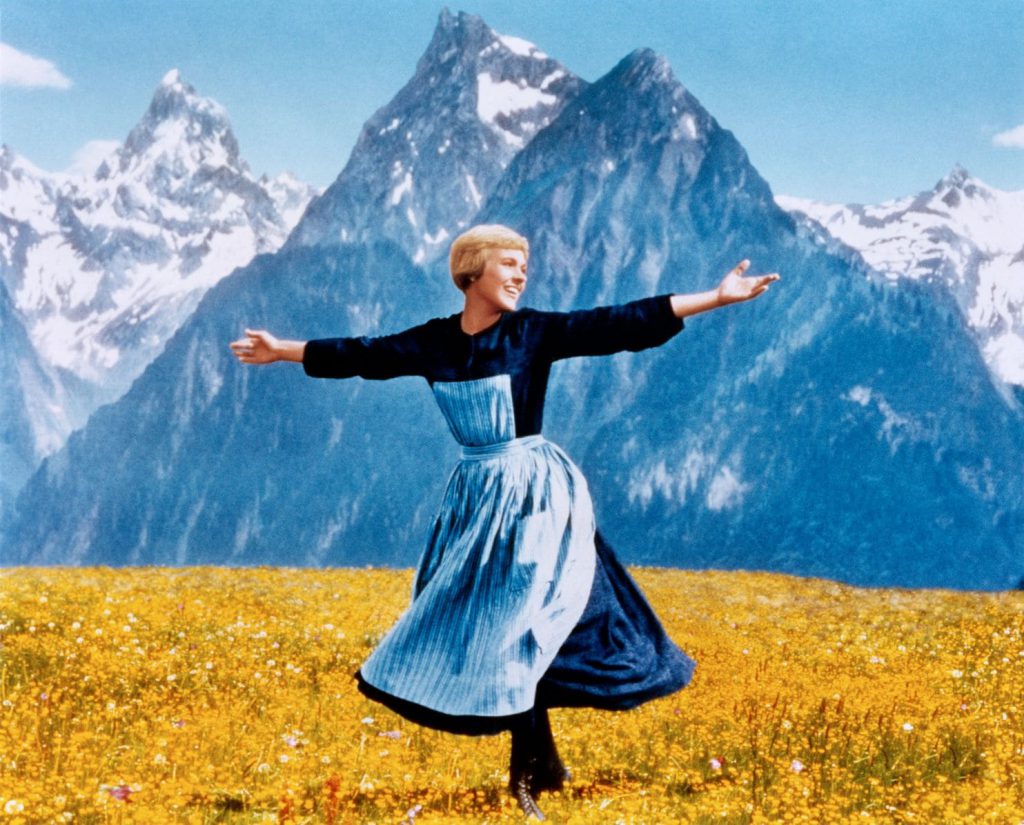
The following comes from the book “Home Work: A Memoir of My Hollywood Years.” In this excerpt, Julie Andrews looks back on filming the iconic opening sequence of “The Sound of Music.”
Ironically, most of our film’s magical opening sequence was the last thing we filmed in Austria. Robert Wise, our director, had envisioned an aerial shot to be filmed from a helicopter that would discover me — a speck in the vast alpine landscape — walking toward the camera. He selected a beautiful stretch of countryside high in the mountains, flanked by woods on two sides. Our huge playback speakers were camouflaged among the trees, as was our crew, so that no one else was in view.
I was placed at one end of the meadow. A helicopter hovered behind the trees at the other end, waiting for me to begin my walk toward it. Initially, I couldn’t hear my cue since the crew’s voices were muffled by the trees. Even the playback, turned up as loud as possible, was almost inaudible over the “clackety-clack” of the helicopter. Finally, Marc Breaux was given a bullhorn, through which he yelled, “GO, JULIE!”
I began my walk, and as I did, the helicopter rose up and over its cover. It came at me sideways, looking rather like a giant crab. A brave cameraman named Paul Beeson was hanging out of it, strapped precariously to the side where a door would have been, his feet resting on the runners beneath the craft. Strapped to him was the heavy camera equipment. As the helicopter drew closer, I spun around with my arms open as if about to sing. All I had to do was walk, twirl, and take a breath. This required several takes, to be sure that both the helicopter and I hit our marks correctly, the camera was in focus, there was no helicopter shadow, and that everything timed out. Once the take was complete, the helicopter soared up and around me and returned to its original position. At that point I’d run back to the end of the field to start all over again, until Bob was satisfied that he had the perfect take.
The problem was that as I completed that spin and the helicopter lifted, the downdraft from the jet engine was so powerful, it dashed me to the ground. I’d haul myself up, spitting mud and grass and brushing it off my dress, and trek back to my starting position. Each time the helicopter encircled me, I was flattened again.
I became more and more irritated—couldn’t they see what was happening? I tried to indicate for them to make a wider circle around me. I could see the cameraman, the pilot, and our second unit director on board, but all I got was a thumbs-up and a signal to do it again. Finally, the shot was deemed acceptable, and I was grateful to return to my hotel and take a long, hot bath.
By this time, largely due to the weather, we were three weeks behind schedule, seriously over budget, and the studio had summoned the rest of the cast back to L.A. We tried to capture the next small section of the song for several days, but the relentless rain thwarted our attempts yet again. Day after day, we waited for a break in the clouds, everyone cold, damp, and longing to go home.
There was still quite a bit left to shoot, as each small segment of the song was its own little scene. The brook, for example, was actually man-made, dug out by our crew, lined with plastic and filled with water, boulders, and ferns. Our host farmer lost patience with us, claiming that the film crew’s presence was disrupting his cows’ milk production. Overnight, he took a pitchfork to the plastic lining and punctured it enough times that all the water drained away. Bob was devastated—the 20th Century Fox bigwigs were hounding him to wrap things up, but they had no idea of the obstacles that he was wrestling with.
Finally, Bob promised the studio that if he didn’t get the last shot he was waiting for, he’d wrap the company nonetheless and come home the following day. By some miracle, that afternoon the clouds parted for a brief half hour, the sun came out, and we got our shot. Bob later said that those constant lowering cumuli set against the magnificent Alps gave the film the drama and authenticity it needed — something we couldn’t have achieved any other way.
From the book “Home Work” by Julie Andrews. Copyright © 2019 by Lacebark Entertainment, Inc. Reprinted by permission of Hachette Books, New York, N.Y. All rights reserved.
Julie Andrews is an Oscar-winning actress whose film credits include “Mary Poppins,” “The Sound of Music” and “Victor Victoria.” Emma Walton Hamilton, with her mother, Andrews, has written more than 30 books for children and young adults.
By Julie Andrews and Emma Walton Hamilton
Hachette. 352 pp. $30
Julie Andrews Remembers Becoming Mary Poppins
In an excerpt from her memoir Home Work, Andrews recalls the production process of the 1964 Disney classic, from her first nervous moments on camera to the pleasures of dancing with Dick Van Dyke.
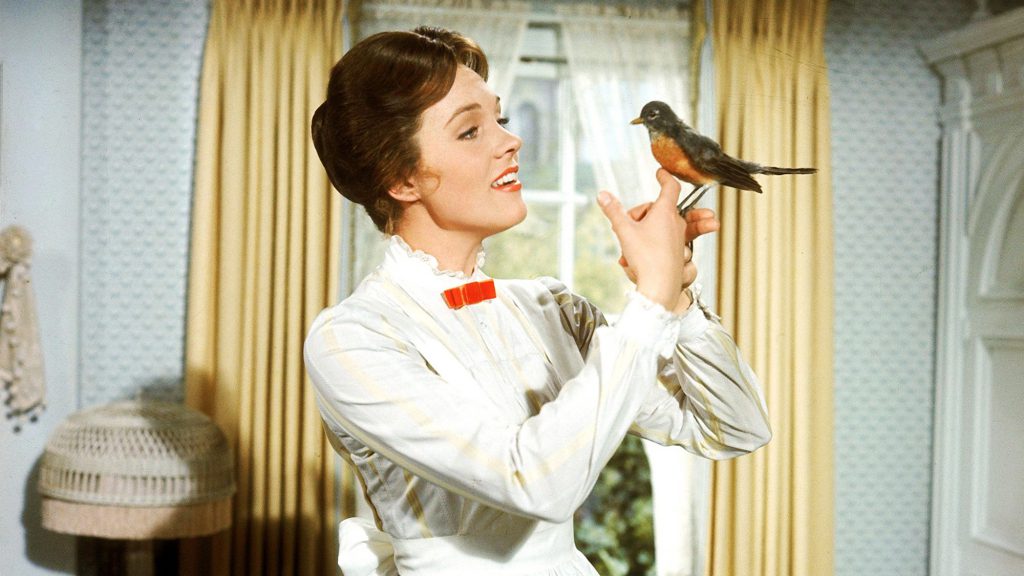
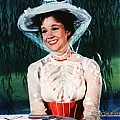
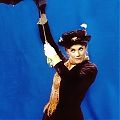
In her 2008 memoir Home, Academy Award winner Julie Andrews wrote about her early years—growing up in a blitz-ravaged London, winning over audiences and critics in My Fair Lady and Camelot on Broadway, and preparing to head West for her first film role. In her second memoir, Home Work—out October 15—Andrews, writing with her daughter Emma Walton Hamilton, picks up where Home left off, taking readers through her storied movie career. In these excerpts from the memoir’s first chapter, Andrews describes in exquisite detail her experiences making Mary Poppins: the learning curve she faced moving from the stage to the Disney lot; meeting her costar Dick Van Dyke; and the challenges of filming the practically perfect nanny’s flying scenes.
It had been eight years since I first made the leap across the Atlantic from England to Broadway. At that time, I was 19, totally on my own, and desperately worried about leaving my dysfunctional family behind and the huge unknown that awaited me. I didn’t know where I would be living or how to balance a checkbook, let alone function in an overwhelming metropolis like New York City.
Now, here I was, with three shows—The Boy Friend, My Fair Lady, and Camelot—and several thousand performances on Broadway and in London behind me, beginning yet another journey into a new unknown: Hollywood.
This time, thankfully, I was not alone. My husband, Tony, was with me. We were embarking on this new adventure together, along with our baby daughter, Emma. We were green as grass, had no knowledge of the film industry, and could not possibly envision what lay ahead—but we were industrious, open-minded, and we had each other. We were also blessed to have the great Walt Disney to guide us.
Tony and I spent a few days getting over jet lag and settling in. Emma was only three months old, and we had brought her nanny, Wendy, with us to help care for her during the five days a week that we would be working. On weekends, she could take time off and we would have Emma to ourselves. I was still breastfeeding my baby, and I hoped to do so for as long as possible. I had a fair way to go to get myself back into pre-pregnancy shape, so I was grateful that there would be a period of dance rehearsals before filming began.
A few days after our arrival, I went with Tony to the Walt Disney Studios, located in Burbank. Tony and I had visited there once before, and we were again struck by the sunny ease of the place; the shady trees and beautifully manicured lawns upon which people relaxed or played table tennis during their lunch hour. Neatly arranged bungalow offices, several large soundstages, construction sheds, and a main theater were dominated by a much larger three-story structure known as the Animation Building. Walt’s suite of offices was on the top floor, and below were airy workspaces where the artists and animators created their magic.
We had lunch with Walt and his coproducer/screenwriter Bill Walsh in the commissary, long recognized as the best in Hollywood for its great food and friendly atmosphere. Walt’s persona was that of a kindly uncle—twinkly-eyed, chivalrous, and genuinely proud of all he had created. His international empire encompassed film, television, and even a theme park, yet he was modest and gracious. Our new friend Tom Jones once said to me that you didn’t last very long at the company if you were mean-spirited or bad-tempered.
I was provided with a car and driver for the first two or three weeks, but eventually, the Studios loaned me a vehicle of my own when it was assumed that I knew my way around. I was nervous about driving on the freeways and received guidelines: “Stick to the right lane, and get off at Buena Vista.” “Stay in the slowest lane; you don’t need to cross lanes at all.” “Go dead straight until you come to your exit,” etc. Being English, I’d never driven on a freeway, or on the right-hand side of the road, and it definitely took some getting used to.
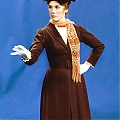
My first weeks at the Walt Disney Studios were consumed with meetings, and wardrobe and wig fittings. I was struck by the differences between preparing for a film role and preparing for a stage performance. For a play or musical, the first few days are spent in script readings and laying out the staging of the scenes. Measurements are taken and you see costume sketches, but fittings generally don’t happen until well into the rehearsal process. A film, however, is usually shot out of sequence, and in very small increments. Blocking for any scene isn’t addressed until the day of the shoot. It felt odd to be fitting costume elements and wigs for a role I had yet to portray, but to some degree, seeing those costumes helped me begin to formulate Mary’s character.
The beloved actress-singer riffs on humor, whistling and new beginnings
by Julie Andrews, AARP, October 4, 2019

BRIAN BOWEN SMITH
Always be prepared
Discipline, for me, is very important. In other words, if I’ve done my homework, if I know what I’m doing, then I can launch rather than just flail around. I was trained that way all my life by Madame Lilian Stiles-Allen. From when I was age 9 until the day she died in 1982, she was my singing teacher and taught me good diction, placement, everything. A wonderful lady and a huge mentor. How lucky can a girl get?
A spoonful of sugar
Well, God help me if I wasn’t nice. My mum used to say, “Don’t you dare pull rank. There’s always someone who can do the same thing you do and much better than you.” And I was young and knew I had a lot to learn.
Regrets, she’s had a few
Everybody thinks I come from Windsor Castle or something. But I was so busy working as a kid. The only thing I had time for was to read on trains and planes. When I didn’t go to college because I was working, I said to my mum, “Are you sure I’m not going to miss college?” She said, “Oh, you’ll have a much better education from life.” But I always wished I’d had a real education.
How Mary Poppins’ creator viewed Andrews as the nanny
I don’t know what P. L. Travers thought. She said to me, “You’re very pretty, and you’ve got the nose for it.” I’m sure she laughed all the way to the bank. She was very tough and canny.
Having a voice …
I would have been quite a sad lady if I hadn’t had the voice to hold on to. The singing was the most important thing of all, and I don’t mean to be Pollyanna about how incredibly lost I’d have been without that.
… And losing her voice, in 1997
When I woke up from an operation to remove a cyst on my vocal cord, my singing voice was gone. I went into a depression. It felt like I’d lost my identity. But by good fortune, that’s when my daughter Emma and I had been asked to write books for kids. So along came a brand-new career in my mid-60s. Boy, was that a lovely surprise. But do I miss singing? Yes, I really do.
Laughing together
I can’t imagine a good marriage without a good sense of humor. We laughed a lot. Blake [Edwards, the late director, to whom she was married for 41 years] said to me, “The minute I saw you laughing at the outtakes I showed you, I thought, That’s the girl for me.”
Whistle a happy tune
I’d love to be able to paint. I’d love to be a good cook, but I’m rotten.
I don’t have the patience for it. But I have to say, I’m a very good whistler. A lot of singers are. —As told to Margy Rochlin
Julie Andrews, 84, is an actress and the author of Home Work: A Memoir of My Hollywood Years.
https://www.aarp.org/entertainment/celebrities/info-2019/julie-andrews-what-i-know-now.html
In this follow-up to her critically acclaimed and bestselling memoir Home, the enchanting Julie Andrews picks up her story with her arrival in Hollywood, sharing the career highlights, personal experiences, and reflections behind her astonishing career, including such classics as Mary Poppins, The Sound of Music, Victor/Victoria and many others.
In Home, the number one New York Times international bestseller, Julie Andrews recounted her difficult childhood and her emergence as an acclaimed singer and performer on the stage. In her new memoir, Home Work, Julie picks up the story with her arrival in Hollywood and her astonishing rise to fame as two of her early films — Mary Poppins and The Sound of Music — brought her instant and enormous success, including an Oscar. It was the beginning of a career that would make Julie Andrews an icon to millions the world over.
In Home Work, Julie describes her years in Hollywood-from the incredible highs to the challenging lows. Not only does she detail her work in now-classic films and her collaborations with giants of cinema and television; she also unveils her personal story of adjusting to a new and often daunting world, dealing with the demands of unimaginable success, being a new mother, moving on from her first marriage, embracing two step-children, adopting two more children, and falling in love with the brilliant and mercurial Blake Edwards. The pair worked together in numerous films, culminating in Victor/Victoria, the gender-bending comedy that garnered multiple Oscar nominations.
Told with her trademark charm and candor, Home Work takes us on a rare and intimate journey into an astonishing life that is funny, heartbreaking, and inspiring.
Released in UK September 5 2019
Released in US October 15 2019
Also out as audio book!
Will be posting more news when we hear it.
Shared from her official Facebook site
It’s been an age since I’ve posted – I am immersed in a writing project. But today, I have to stop everything and convey…
Slået op af Julie Andrews i Torsdag den 21. juni 2018