simplyjulieandrews.com   |               
Latest Images
/photos  -  check out over +2,000 photos of Julie Andrews and still counting
1.jpg
21.jpg
1_28129.jpg
1_28229.jpg
12.jpg
qe_28229.jpg
qe_28129.jpg
saint_q_28229.jpg
saint_q_28329.jpg
saint_q_28129.jpg
Singin_0011.jpg
Spotlight on


Latest Project


Latest News

In her revelatory book, the Mary Poppins actress reflects on her career, marriage, and friendship with Carol Burnett.

I’m old enough to remember going to see Mary Poppins at the movie theater in 1964, and I still know the words to every song from that supercalifragilisticexpialidocius movie. Not only did I see The Sound of Music at the movies a few years later, but my parents played the soundtrack so many times, I also still know that by heart. Of course, by then, I’d already fallen in love with Julie Andrews. It was impossible not to.

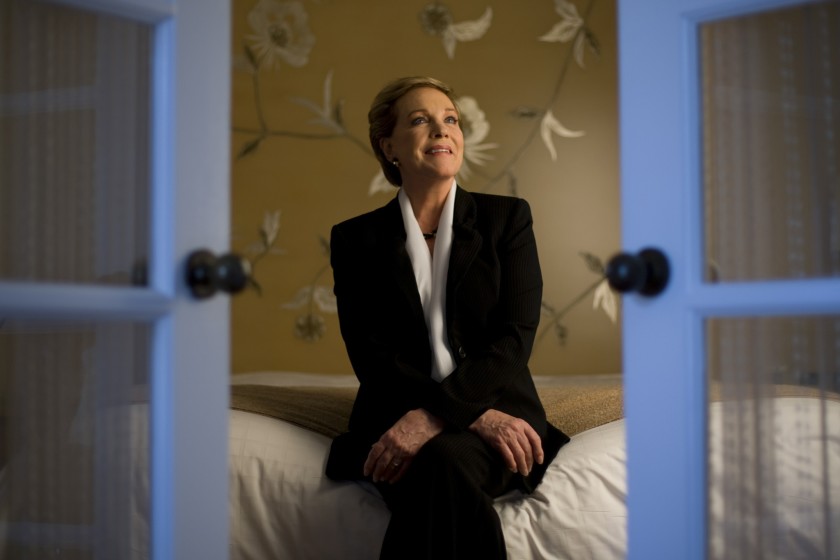
Her new memoir, Home Workout now—is a quiet revelation. And by quiet I don’t mean dull. The book is packed with emotion, action, gossip, and fascinating tidbits about craft. The Julie Andrews we get to know is salty, funny, passionate, hard-working, gracious, and above all, a brilliant vocalist and actress who has braved many disappointments, including the death of her beloved husband and the loss of her singing voice. I was lucky enough to have the opportunity to chat with her on the occasion of her new book’s publication.


I devoured every single word of Home Work. And your memory was supported in putting it together by the diary you kept, right?

Over the years, writing in my diary has helped keep me sane. Things were coming at me so fast. I had to write them down to process them. And now I have the diaries to draw on for the book.

You started performing at a very young age—you didn’t have much of what we think of as a childhood. Your parents didn’t provide a lot of stability.

(Laughs) Well, it was a very unusual childhood, that’s for sure.

What did you take away from it?

A lot of experience I didn’t realize was valuable, at the time. I did wonder when I was endlessly touring around in vaudeville, what was the good of it? What was the point? Was I just going to keep doing that for the rest of my life? But then years later, which I talk about in the book, when I began filming on Mary Poppins, all the things that I’d learned in vaudeville came into play. I could sing all those wonderful songs, the ones where everyone kicks up their heels, like Supercalifragilistic, because they did have a slightly vaudevillian flavor. And I felt I could embrace and use my experience. It seems nothing is really wasted in life, although you think it might be, at the time.

When did you first realize how extraordinary your voice was? You had such a pure soprano that at times, you write, only dogs could hear it…

When it really started to work was when I began training with my superb teacher, the wonderful Madam Stiles-Allen. And she was my singing instructor for many years. Her encouragement and the work I did with her—which was pretty intense—gave me a sense of assurance. But more than anything, with all that was going on in my life; my singing voice gave me an identity that I could hold onto. Everything else—touring, my family—was rather chaotic, but I had the discipline of singing, and the realization that it was a gift. That helped me feel calmer and very grateful.

I loved the way you described how you handled not getting the My Fair Lady movie role, and how you’d drive by the studio where it was being made and wave. At one point, you realized that if you’d gotten that role instead of Audrey Hepburn, you would not have been able to do Mary Poppins. The timing wouldn’t have worked.

That’s right. It’s very hard to be upset about not getting My Fair Lady when Walt Disney comes along about three months later and says, “Would you like to come to Hollywood and do Mary Poppins?”

And Walt Disney was really supportive and kind to you—you had a lovely relationship with him…

Yes, we did have a lovely relationship, and he had a persona that was very…I think I’d describe him as sort of avuncular and friendly, and very dear to me, particularly. He had a tremendous gift for spotting talent. As I say in the book, I think, people didn’t last very long in those days at Walt Disney Studios if they weren’t decent, nice people. The angry ones, or the disturbed ones, very quickly disappeared and it was really a pleasant lot and a wonderful way to begin learning about movies.

You had some sense as to how big Mary Poppins could become because it was Disney, but on the other hand you were learning on the job, not thinking too much about the outcome.

I don’t know if anybody knows right away that something is going to be enormously successful. I certainly don’t think anyone at the time we were making Poppins thought that, either. You just put your head down, dig in, and learn. I was so green, so I couldn’t even begin to predict that it might be successful. I knew that it was great fun and that it was done with great care, and that everyone involved in it was giving it their all, but I really had nothing to judge it by. So one just did the work. How lucky we were!

And I didn’t put two and two together about being a nanny in Mary Poppins and being a nanny in The Sound of Music until I read about how The Sound of Music gave you a little pause at first because you were reluctant to play a nanny again.

Yes, with the success of Mary Poppins, I didn’t want to be so typecast that nobody ever thought of me for anything else, you know? But it was a very different experience in every way. Because as I mentioned, I think, it was a whole different scale. It was, I think, Cinemascope, which Poppins wasn’t. Everything from the size of the cameras, the detail, and the pictures that the movie recorded, and everything about it was slightly raised, a little larger and bigger than Poppins had been.

Continue reading  »

Posted on October 15, 2019 / by admin in 2019, Home Work: A Memoir of My Hollywood Years, memoir

“The hardest thing with this book was finding a voice,” Julie Andrews says.

She is talking, in a phone interview along with her co-writer, her daughter and longtime collaborator Emma Walton Hamilton, about her new memoir “Home Work,” which arrives on Tuesday.

The statement sounds, at first, like a joke — the voice of Julie Andrews is, after all, one of the most famous in the world, and not just the impossibly crystalline expanse of her singing voice, which, alas, was irreparably damaged during surgery in 1997. Whether in performance, interview or on the pages of the many books she has written, Andrews’ melodic cadence, often wry though always kind, is instantly recognizable.

But memoirs, like memories, are tricky things, the past reconstructed in the present, and finding a tone that reflects the reality of the former and the perspective of the latter is not easy. Although Andrews had already written one memoir, “Home,” she wanted “Home Work” to feel different because the two portions of her life were different.

In ‘Home’ I was an adult telling a child’s story,” Andrews says, speaking from Sag Harbor, N.Y., where she lives, “but in ‘Home Work’ I am telling the story of my adult life. I wanted to write about how things came at me, about paying my dues, about learning my craft, learning who I was, learning to parent, all the homework that I did.”

The tone she and Hamilton settled on is conversational and strikingly matter-of-fact. Just like the title.

After all, when choosing a title for the story of her transition from “star of stage” to “star of stage, screen, television and the hearts of millions,” Andrews could have gone big. Very big. Her career certainly did.

While nothing like an overnight success — suggest that she took Hollywood by storm and you will be reminded, gently but firmly, that Andrews began working the British vaudeville circuit at 10 and made her Broadway debut at 19 — the fact remains that she began her film career by winning an Oscar for her very first movie (“Mary Poppins”), a feat she followed up a year later with the critically acclaimed antiwar drama “The Americanization of Emily” and a little picture called “The Sound of Music.”

Steve Right in the Afternoon, only up for 30 days!!

https://www.bbc.co.uk/programmes/m0009bt8

The Ray D’Arcy Show

https://www.rte.ie/radio/radioplayer/html5/?fbclid=IwAR3tJvD4XF5583HjtN6mxc88lQgjbbRxXzpyOdeLJ6YjFLjoidxbP6NkeOE#/radio1/11100476

October 12

The following comes from the book “Home Work: A Memoir of My Hollywood Years.” In this excerpt, Julie Andrews looks back on filming the iconic opening sequence of “The Sound of Music.”

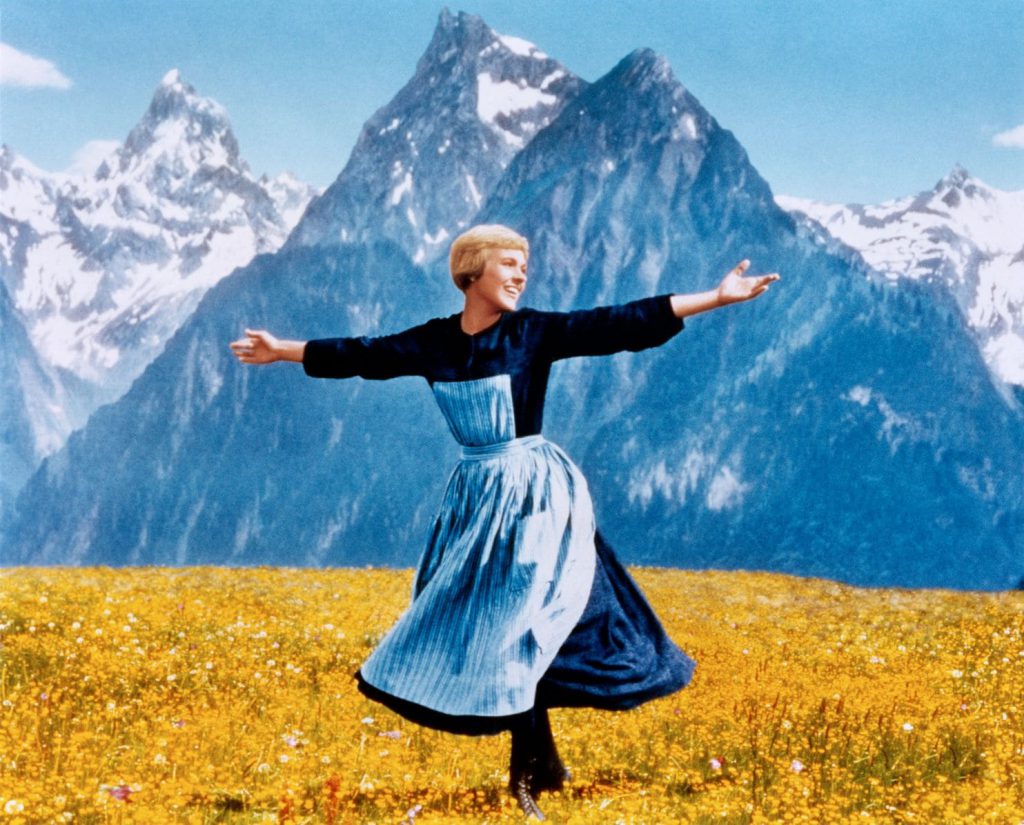
Ironically, most of our film’s magical opening sequence was the last thing we filmed in Austria. Robert Wise, our director, had envisioned an aerial shot to be filmed from a helicopter that would discover me — a speck in the vast alpine landscape — walking toward the camera. He selected a beautiful stretch of countryside high in the mountains, flanked by woods on two sides. Our huge playback speakers were camouflaged among the trees, as was our crew, so that no one else was in view.

I was placed at one end of the meadow. A helicopter hovered behind the trees at the other end, waiting for me to begin my walk toward it. Initially, I couldn’t hear my cue since the crew’s voices were muffled by the trees. Even the playback, turned up as loud as possible, was almost inaudible over the “clackety-clack” of the helicopter. Finally, Marc Breaux was given a bullhorn, through which he yelled, “GO, JULIE!”

I began my walk, and as I did, the helicopter rose up and over its cover. It came at me sideways, looking rather like a giant crab. A brave cameraman named Paul Beeson was hanging out of it, strapped precariously to the side where a door would have been, his feet resting on the runners beneath the craft. Strapped to him was the heavy camera equipment. As the helicopter drew closer, I spun around with my arms open as if about to sing. All I had to do was walk, twirl, and take a breath. This required several takes, to be sure that both the helicopter and I hit our marks correctly, the camera was in focus, there was no helicopter shadow, and that everything timed out. Once the take was complete, the helicopter soared up and around me and returned to its original position. At that point I’d run back to the end of the field to start all over again, until Bob was satisfied that he had the perfect take.

The problem was that as I completed that spin and the helicopter lifted, the downdraft from the jet engine was so powerful, it dashed me to the ground. I’d haul myself up, spitting mud and grass and brushing it off my dress, and trek back to my starting position. Each time the helicopter encircled me, I was flattened again.

I became more and more irritated—couldn’t they see what was happening? I tried to indicate for them to make a wider circle around me. I could see the cameraman, the pilot, and our second unit director on board, but all I got was a thumbs-up and a signal to do it again. Finally, the shot was deemed acceptable, and I was grateful to return to my hotel and take a long, hot bath.

By this time, largely due to the weather, we were three weeks behind schedule, seriously over budget, and the studio had summoned the rest of the cast back to L.A. We tried to capture the next small section of the song for several days, but the relentless rain thwarted our attempts yet again. Day after day, we waited for a break in the clouds, everyone cold, damp, and longing to go home.

There was still quite a bit left to shoot, as each small segment of the song was its own little scene. The brook, for example, was actually man-made, dug out by our crew, lined with plastic and filled with water, boulders, and ferns. Our host farmer lost patience with us, claiming that the film crew’s presence was disrupting his cows’ milk production. Overnight, he took a pitchfork to the plastic lining and punctured it enough times that all the water drained away. Bob was devastated—the 20th Century Fox bigwigs were hounding him to wrap things up, but they had no idea of the obstacles that he was wrestling with.

Finally, Bob promised the studio that if he didn’t get the last shot he was waiting for, he’d wrap the company nonetheless and come home the following day. By some miracle, that afternoon the clouds parted for a brief half hour, the sun came out, and we got our shot. Bob later said that those constant lowering cumuli set against the magnificent Alps gave the film the drama and authenticity it needed — something we couldn’t have achieved any other way.

From the book “Home Work” by Julie Andrews. Copyright © 2019 by Lacebark Entertainment, Inc. Reprinted by permission of Hachette Books, New York, N.Y. All rights reserved.

Julie Andrews is an Oscar-winning actress whose film credits include “Mary Poppins,” “The Sound of Music” and “Victor Victoria.” Emma Walton Hamilton, with her mother, Andrews, has written more than 30 books for children and young adults.

HOME WORK

By Julie Andrews and Emma Walton Hamilton

Hachette. 352 pp. $30
Posted on October 12, 2019 / by admin in 2019, Home Work: A Memoir of My Hollywood Years, memoir, News


Simply Julie Andrews is an unofficial fansite for Julie Andrews. We are in no way affiliated with her, her management and we don't know anyone who is. This site is non-profit, and is in no way trying to infringe on the copyrights or businesses of any of the entities. All content posted up on this site is used under the Fair Use Copyright Law 107. All images are copyright to their respective owners. If something belongs to you, please email us before taking any legal action and we will give you credit or remove it straight away.