|
|
Steve Right in the Afternoon, only up for 30 days!!
https://www.bbc.co.uk/programmes/m0009bt8
The Ray D’Arcy Show
https://www.rte.ie/radio/radioplayer/html5/?fbclid=IwAR3tJvD4XF5583HjtN6mxc88lQgjbbRxXzpyOdeLJ6YjFLjoidxbP6NkeOE#/radio1/11100476
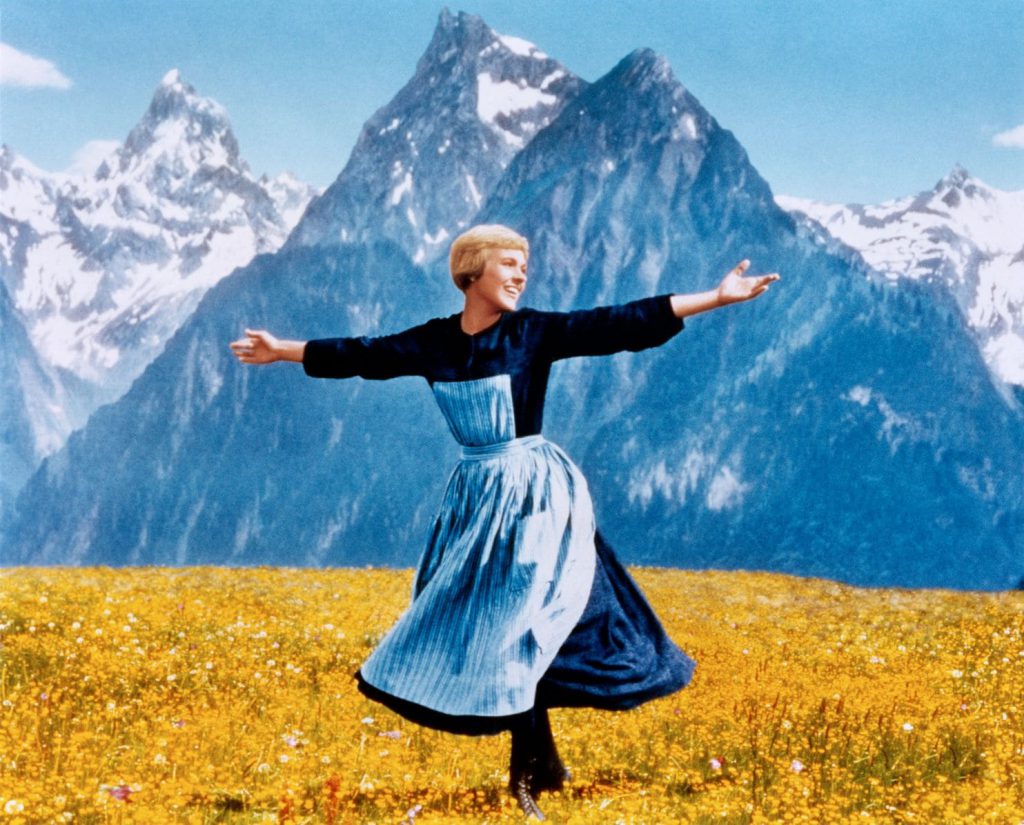
The following comes from the book “Home Work: A Memoir of My Hollywood Years.” In this excerpt, Julie Andrews looks back on filming the iconic opening sequence of “The Sound of Music.”
Ironically, most of our film’s magical opening sequence was the last thing we filmed in Austria. Robert Wise, our director, had envisioned an aerial shot to be filmed from a helicopter that would discover me — a speck in the vast alpine landscape — walking toward the camera. He selected a beautiful stretch of countryside high in the mountains, flanked by woods on two sides. Our huge playback speakers were camouflaged among the trees, as was our crew, so that no one else was in view.
I was placed at one end of the meadow. A helicopter hovered behind the trees at the other end, waiting for me to begin my walk toward it. Initially, I couldn’t hear my cue since the crew’s voices were muffled by the trees. Even the playback, turned up as loud as possible, was almost inaudible over the “clackety-clack” of the helicopter. Finally, Marc Breaux was given a bullhorn, through which he yelled, “GO, JULIE!”
I began my walk, and as I did, the helicopter rose up and over its cover. It came at me sideways, looking rather like a giant crab. A brave cameraman named Paul Beeson was hanging out of it, strapped precariously to the side where a door would have been, his feet resting on the runners beneath the craft. Strapped to him was the heavy camera equipment. As the helicopter drew closer, I spun around with my arms open as if about to sing. All I had to do was walk, twirl, and take a breath. This required several takes, to be sure that both the helicopter and I hit our marks correctly, the camera was in focus, there was no helicopter shadow, and that everything timed out. Once the take was complete, the helicopter soared up and around me and returned to its original position. At that point I’d run back to the end of the field to start all over again, until Bob was satisfied that he had the perfect take.
The problem was that as I completed that spin and the helicopter lifted, the downdraft from the jet engine was so powerful, it dashed me to the ground. I’d haul myself up, spitting mud and grass and brushing it off my dress, and trek back to my starting position. Each time the helicopter encircled me, I was flattened again.
I became more and more irritated—couldn’t they see what was happening? I tried to indicate for them to make a wider circle around me. I could see the cameraman, the pilot, and our second unit director on board, but all I got was a thumbs-up and a signal to do it again. Finally, the shot was deemed acceptable, and I was grateful to return to my hotel and take a long, hot bath.
By this time, largely due to the weather, we were three weeks behind schedule, seriously over budget, and the studio had summoned the rest of the cast back to L.A. We tried to capture the next small section of the song for several days, but the relentless rain thwarted our attempts yet again. Day after day, we waited for a break in the clouds, everyone cold, damp, and longing to go home.
There was still quite a bit left to shoot, as each small segment of the song was its own little scene. The brook, for example, was actually man-made, dug out by our crew, lined with plastic and filled with water, boulders, and ferns. Our host farmer lost patience with us, claiming that the film crew’s presence was disrupting his cows’ milk production. Overnight, he took a pitchfork to the plastic lining and punctured it enough times that all the water drained away. Bob was devastated—the 20th Century Fox bigwigs were hounding him to wrap things up, but they had no idea of the obstacles that he was wrestling with.
Finally, Bob promised the studio that if he didn’t get the last shot he was waiting for, he’d wrap the company nonetheless and come home the following day. By some miracle, that afternoon the clouds parted for a brief half hour, the sun came out, and we got our shot. Bob later said that those constant lowering cumuli set against the magnificent Alps gave the film the drama and authenticity it needed — something we couldn’t have achieved any other way.
From the book “Home Work” by Julie Andrews. Copyright © 2019 by Lacebark Entertainment, Inc. Reprinted by permission of Hachette Books, New York, N.Y. All rights reserved.
Julie Andrews is an Oscar-winning actress whose film credits include “Mary Poppins,” “The Sound of Music” and “Victor Victoria.” Emma Walton Hamilton, with her mother, Andrews, has written more than 30 books for children and young adults.
By Julie Andrews and Emma Walton Hamilton
Hachette. 352 pp. $30

By PATRICK J. KIGER
OCT. 13, 2019 3:41 PM
After her breakthrough in “Mary Poppins,” Julie Andrews worried that taking the role of Maria in “The Sound of Music” might lead to being typecast as a nanny. The short, blond look she sported in the second film was actually designed to cover up a hairstyling mishap that turned her normally brown hair bright orange. Visiting the Von Trapp villa in Austria for the location shooting turned out to be a disturbing experience once she learned that the place had been taken over during World War II by SS leader Heinrich Himmler.
Those are a few of the intriguing tidbits in Andrews’ new book, “Home Work: A Memoir of My Hollywood Years,” written with daughter Emma Walton Hamilton. But unlike many Hollywood memoirs these days, it doesn’t contain any shocking or titillating revelations.
Instead, the 84-year-old British-born actress and singer comes across pretty much as the Julie Andrews that we admire on the screen — graceful, elegant and wholesome, but not particularly complicated or troubled.
“Home Work” is the story of an ordinary person blessed with extraordinary gifts, including a soaring, angelic soprano voice, whose big struggle was to maintain that normalcy in a Hollywood rife with exploitation and excess.
As detailed in her previous book, 2008’s “Home: A Memoir of My Early Years,” Andrews got her start in show business at age just before her tenth birthday, standing on a beer crate to reach the microphone as she sang in her mother and stepfather’s vaudeville act. By the time she was a teenager, she had become her family’s main means of support, roaming England and trying to cheer up dreary dressing rooms with a bunch of flowers between twice-an-evening performances in smoke-filled halls full of inebriated adults.
The young Andrews, who never had time for an education, said she feared for her future in British vaudeville’s dying days. She was saved by the grace of her talent, which led producers to cast her in British musical theater. Andrews’ performance in “Cinderella” at the London Palladium was so good she got an offer to cross the Atlantic and play the lead role in a Broadway production of “The Boy Friend,” just before her 19th birthday.
During rehearsals, an American producer, Cy Feuer, took the inexperienced actress out to the theater’s fire escape and gave her a bit of sage advice: Abandon any trace of camp or shtick, and play her character as simply and truthfully as she could. Andrews did just that and “The Boy Friend” became a smash hit.
That led Alan Jay Lerner and Frederick Loewe, those giants of the Broadway musical, to offer her the stage role of Eliza Doolittle in “My Fair Lady,” where she honed her craft under the supervision of legendary director Moss Hart. After seeing her perform in “Camelot,” Walt Disney enticed Andrews to Hollywood for the lead in “Mary Poppins.”
Andrews recounts how she headed west with then-husband, set-director Tony Walton, and their infant daughter Emma for a crash course in film acting alongside the more experienced comedian Dick Van Dyke.
Andrews admits she was unhappy about being passed over for the role of Eliza Doolittle in the film version of “My Fair Lady,” in favor of non-singer Audrey Hepburn. (Marni Nixon, the famous Hollywood “ghost singer,” did the actual vocals in the film.) But Andrews says she ultimately felt grateful for the snub, because it enabled her to star in “Mary Poppins.”
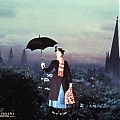
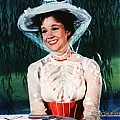
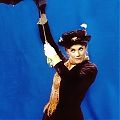
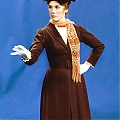
Of all her films, “Mary Poppins” gets the most lavish, detailed description in “Home Work,” from the ballet-influenced walk she developed for her character, to the advice she gave Van Dyke as he struggled to approximate a cockney accent. She recalls Disney in glowing terms — “always very encouraging and full of bonhomie” — and learned, to her amazement, about the daunting amount of editing, re-recording of dialogue and other tinkering that a major production required to get into theaters.
Andrews’ debut film earned her a lead actress Oscar in 1965. By then, she already had another massive musical hit, “The Sound of Music.” The most interesting part of that production for her was traveling to Austria to shoot on location, where she was moved by the beauty of the mountains and chilled to learn about the Himmler connection to the villa. “You can literally feel the evil that once permeated those walls,” she recalls.
She reveals that her favorite song in the film is “Edelweiss,” even though she only got to sing it in the Von Trapp ensemble, not as a solo.
Back in Hollywood, Andrews — still in many ways a small-town English girl — struggled with press appearances and other requisites of stardom. She and Tony Walton drifted apart, due to the frequent separations required by their work. In an effort to save her marriage, Andrews sought help from a psychoanalyst and even briefly considered abandoning her acting and singing career, until her therapist advised her that it would take her a long time to become as good at anything else. Moreover, he explained, it was a shame to waste a gift that gave so much pleasure to others.
Andrews’ first marriage didn’t survive, but as she was leaving the therapist’s office one day, she had a chance encounter in the street with the man who would become the love of her life, director and writer Blake Edwards. Initially, he wanted to cast her in his film “Darling Lili,” but a romance soon blossomed and the two eventually married.
Andrews’ portrait of Edwards, to whom she was married until his death at age 88 in 2010, is more revealing than anything she writes about herself. He is as complex as she is straightforward. She describes him as witty, insightful and kind, and a gifted cinematic storyteller, but also prone to depression and dependent upon painkillers to cope with a bad back. She writes that he became embittered by a bullying, callous Hollywood studio culture, which he battled to keep his films from being ruined by executives’ meddling.
Andrews herself seems to float above the 1960s-70s counterculture tumult in Hollywood, an old-fashioned movie star who probably would have been more at home in the Golden Age of the 1940s. Nevertheless, the book documents her encounters with colorful figures such as Alfred Hitchcock, who directed her in “Torn Curtain,” and with the hard-living Elizabeth Taylor and Richard Burton. The lone intersection with “Once Upon a Time … in Hollywood” is when she and Edwards invited martial arts great Bruce Lee to lunch at their home, where he entertained them by springing from his chair into a flying side kick. (“Can Nureyev do this?” Lee asked.)
The most moving part of the book is Andrews’ account of postwar Vietnam and Cambodia, which she visited in the early 1980s as part of a humanitarian delegation. (She has two adopted daughters, Amelia and Joanna, who were Vietnamese orphans.) She devotes more space and vivid detail in the book to those scenes of heart-wrenching deprivation and suffering than she gives to some of her movies. The trip, she notes, changed her “on a profound level,” giving her a new sense of purpose. She became an activist, lobbying for legislation to allow the Asian American children left behind by U.S. servicemen to immigrate to this country.
“I never anticipated any of it,” Andrews says of her film career. “I just took the opportunities that were in front of me and waded in.”
That degree of candor — and Andrews’ refreshing unpretentiousness and gentle sense of bemusement at her life’s adventures — make “Home Work” a book that will appeal to fans of her films, as well as anyone who wants to be reassured that being a celebrity doesn’t have to involve scandal.
Home Work: A Memoir of My Hollywood Years
Julie Andrews
Hachette Books: 352 pages; $30
Kiger has written for GQ, Sierra magazine, Fast Company and History.com. He’s also co-written two nonfiction books, “Poplorica” and “Oops.”
If you go
The Los Angeles Times Book Club and the Ideas Exchange welcome Julie Andrews in conversation with columnist Mary McNamara about “Home Work.”
When: 7:30 p.m., Nov. 18.
Where: Orpheum Theatre, 842 S. Broadway, Los Angeles
More info: latimes.com/bookclub